
There are no projects in the garbage can.
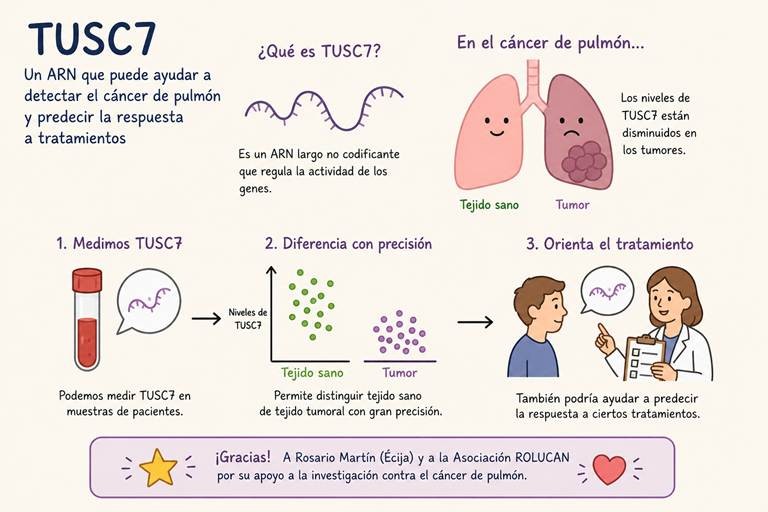
Researchers from GENyO, the University of Granada and the Granada Institute for Biomedical Research have identified TUSC7 as a promising biomarker for lung cancer and demonstrated that one of its mutations alters the behaviour of tumour cells, reinforcing its potential for diagnosis and personalised medicine.
Despite the progress made in recent years, many patients are still diagnosed when the disease is already at an advanced stage. Identifying biomarkers capable of detecting the tumour more accurately and helping to select the most appropriate treatment is one of the major challenges facing cancer research today.
Against this backdrop, researchers from the GENyO Centre, the University of Granada and the Granada Institute for Biomedical Research (ibs.GRANADA) have identified the long non-coding RNA TUSC7 as a promising biomarker in non-small cell lung cancer, the subtype that accounts for approximately 85 per cent of all cases. The study, published in the journal *Biomarker Research*, is led by Pablo Martín-López, a pre-doctoral researcher at the University of Granada, and Professor Marta Cuadros, both lead authors of the paper, under the supervision of Professor Pedro Pablo Medina.
Long non-coding RNAs are molecules which, although they do not produce proteins, perform essential functions by regulating the activity of numerous genes. In recent years, they have attracted considerable interest due to their potential use as biomarkers, but few with genuine clinical potential are currently known.
In this study, the researchers analysed more than 800 long non-coding RNAs in 39 cell lines and 70 lung tumours, identifying thousands of genetic alterations before selecting those most likely to have a biological impact. Among these, TUSC7 stood out, as its expression was significantly reduced in lung tumours compared with healthy tissue.
One of the most significant findings was that TUSC7 levels enable tumour tissue to be distinguished from healthy tissue with a very high degree of accuracy. This finding was validated both in the cohort of patients analysed by the researchers and in an independent international cohort, achieving a diagnostic accuracy of over 96 per cent.
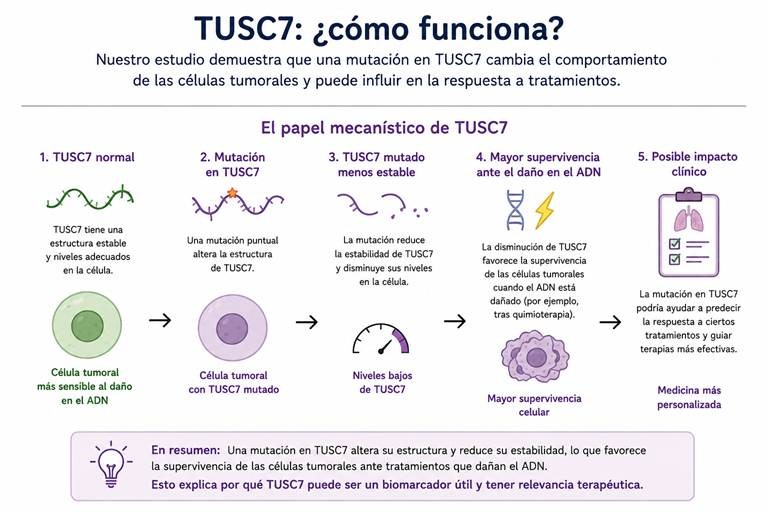
However, the study goes a step further than simply identifying a new biomarker. As well as confirming its diagnostic value, the researchers provide evidence of its biological function. The study demonstrates that a mutation in this RNA alters its structure and stability, promoting the survival of tumour cells when they are subjected to treatments that damage DNA. These results help to explain why TUSC7 may become a clinically relevant biomarker and suggest that, in the future, it could be used not only to improve the diagnosis of lung cancer, but also to help predict how some patients will respond to specific treatments.
“Our work shows that TUSC7 possesses many of the characteristics we look for in a good biomarker: it distinguishes tumour tissue from healthy tissue with great accuracy and, furthermore, plays a biological role that could help predict the response to certain treatments. Although these results will still need to be validated in clinical trials, this discovery opens up a new avenue for developing more accurate diagnostic tools and moving towards personalised medicine in lung cancer,” explains Pedro Pablo Medina Vico, group leader at the GENyO centre, professor at the University of Granada and director of the study.
This work has been funded by research projects from the Spanish Government, the Regional Government of Andalusia and the Spanish Association Against Cancer, as well as through private donations. The researchers would like to express their very special thanks to Rosario Martín, from Écija, whose generous contribution has driven this line of research into lung cancer, as well as to the ROLUCAN Association (Rota Fight Against Cancer) for its ongoing commitment to supporting biomedical research. Thanks to the involvement of individuals and organisations such as these, it is possible to continue driving forward projects that generate knowledge and bring new scientific advances to patients.
Study reference
Martin-López P., Cuadros M. et al. TUSC7 expression and mutational profile define its potential as a diagnostic and therapeutic biomarker in non-small cell lung cancer. Biomarker Research (2026). doi: 10.1186/s40364-026-00916-0. PMID: 41964023; PMCID: PMC13067388. https://link.springer.com/article/10.1186/s40364-026-00916-0
Contact
Pedro P. Medina
pedro.medina@genyo.es
See more news