
No se ha encontrado investigadores para este término.

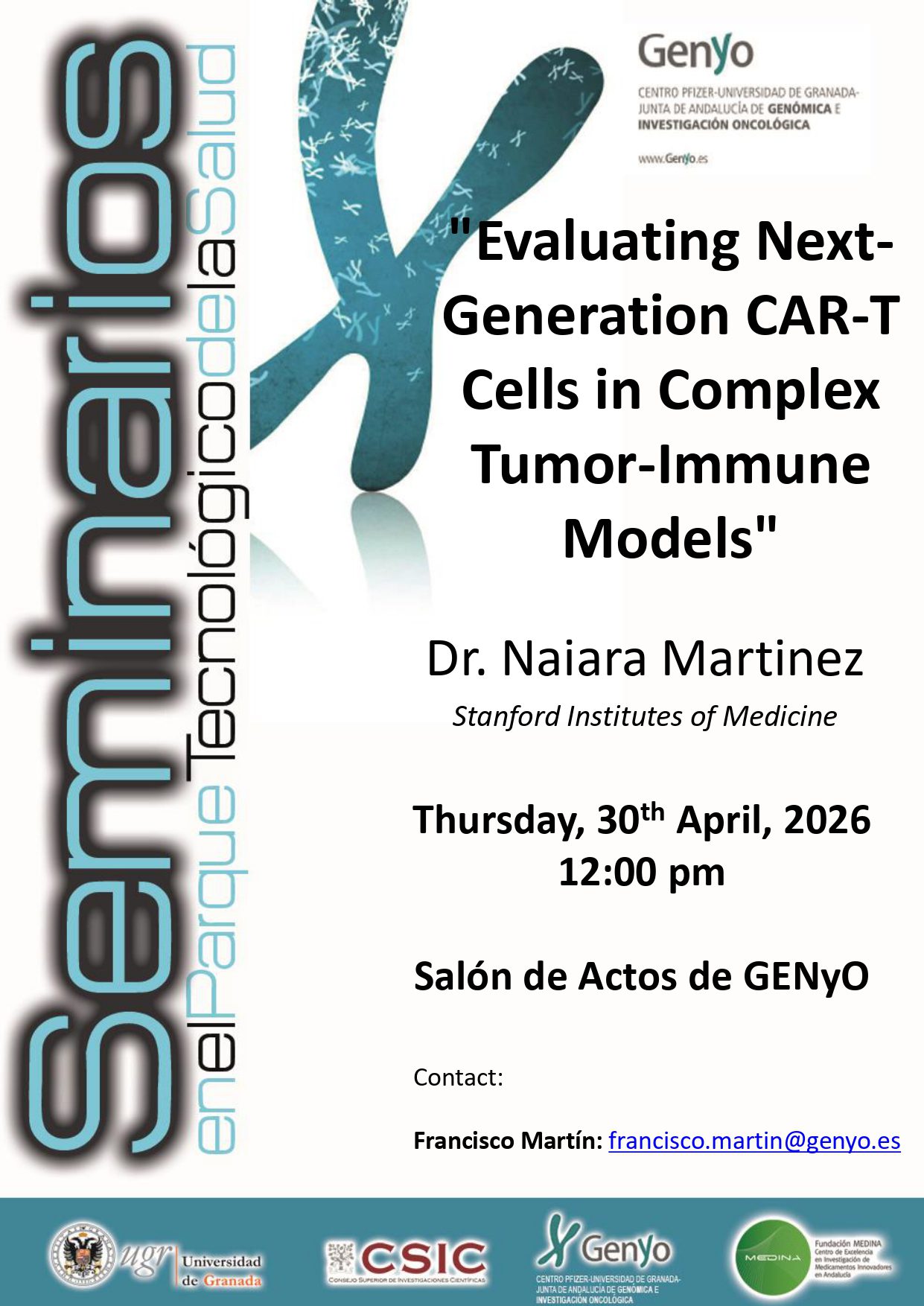
Fecha: Jueves, 30 de abril
Ponente/Speaker: Dra. Naiara Martinez
Stanford Institutes of Medicine
Título/Title: “Evaluating Next-Generation CAR-T Cells in Complex Tumor-Immune Models”
Lugar y hora: Salón de Actos de GENyO a las 12:00h.
Contacto: Francisco Martín: francisco.martin@genyo.es
Resume: Chimeric Antigen Receptor (CAR) T-cell therapy has revolutionized the treatment of hematologic malignancies, yet its clinical efficacy in solid tumors remains limited. Key barriers include poor
tumor trafficking, antigen heterogeneity, and profound immunosuppression driven by myeloid cells and other stromal components within the tumor microenvironment (TME). In response, nextgeneration
CAR-T strategies have been developed to incorporate cell-intrinsic enhancements or engineered cargos designed to sustain T-cell function under the hostile conditions of solid tumors.
However, most immunotherapies, including CAR-T cells, are routinely developed and tested using simplified in vitro systems and xenograft models in immunodeficient mice, which fail to capture the full complexity of the native TME. Importantly, correlative analyses from clinical trials increasingly suggest that myeloid cells within the TME play a central role in limiting CAR-T cell persistence and antitumor activity. A deeper understanding of the dynamic interplay between CAR-T cells and the TME is therefore essential for the rational design of more effective celular therapies for solid cancers.
To address this challenge, we have established murine immunocompetent models that more faithfully recapitulate T cell–TME interactions observed in patients. These novel models have revealed that distinct intrinsic CAR-T cell enhancements differentially remodel the tumor microenvironment, affecting their potency. To further recapitulate and understand these interactions in a human tumor setting, we have also developed and optimized patient-derived tumor immune organoids that preserve neoplastic, stromal, and immune compartments while maintaining the native architecture and cellular crosstalk of the original tumor. These platforms provide a physiologically relevant autologous model in which matched patient-derived CAR T and tumors can be studied under native TME conditions, allowing a more faithful assessment of therapeutic efficacy and the immunosuppressive barriers that limit CAR-T cell function in solid tumors.
By integrating immunocompetent in vivo models with patient-derived tumor immune organoids, this work aims to improve the preclinical evaluation and provide a better understanding of CART cell performance in patients, ultimately accelerating the development of next-generation celular immunotherapies effective against solid tumors.
CV: My scientific career focuses on leveraging immunotherapies to treat malignant brain tumors and pediatric solid tumors. I completed my PhD in 2018 at the Clínica Universidad de Navarra under the supervision of Drs. Ana Patiño and Marta Alonso. My doctoral and early postdoctoral work evaluated new oncolytic adenovirus for pediatric osteosarcoma and pediatric high-grade gliomas, resulted in first-author publications (including Nature Communications and Clinical Cancer Research). But more importantly, the preclinical data generated during my PhD supported the launch of the first clinical trial evaluating the oncolytic adenovirus Delta-24-RGD in pediatric patients with diffuse midline glioma (The New England Journal of Medicine).
The AACR–AstraZeneca Immuno-oncology Research Fellowship supported my work developing an oncolytic virus engineered to deliver an immunostimulatory payload to enhance anti-tumor efficacy (Mol. Cancer Ther). In 2020, building on this experience harnessing the immune system against cancer, I became increasingly interested in T-cell–based therapies and joined the laboratory of Dr. Crystal Mackall at Stanford University, a pioneering group in next-generation cell therapies for pediatric and high-grade brain tumors.
At Stanford, I study how interactions between CAR-T cells and the tumor microenvironment (TME) drive therapeutic failure in solid tumors, and I established the preclinical models needed to interrogate these mechanisms. My current work dissects how intrinsic CAR-T engineering strategies differentially remodel the tumor immune microenvironment in pediatric solid tumors. To enable clinically relevant testing platforms, I collaborate with Dr. Calvin Kuo’s lab to develop advanced 3D tumor immune organoid systems, highlighting patient-derived tumor immune organoids as a powerful approach to model immune–tumor interactions and predict responses to immunotherapies. In July 2025, I received the Kite–Gilead Early Career Award in Cell Therapy Research, supporting my transition toward independence and my current role as a Faculty Instructor at Stanford University.