
No se ha encontrado investigadores para este término.

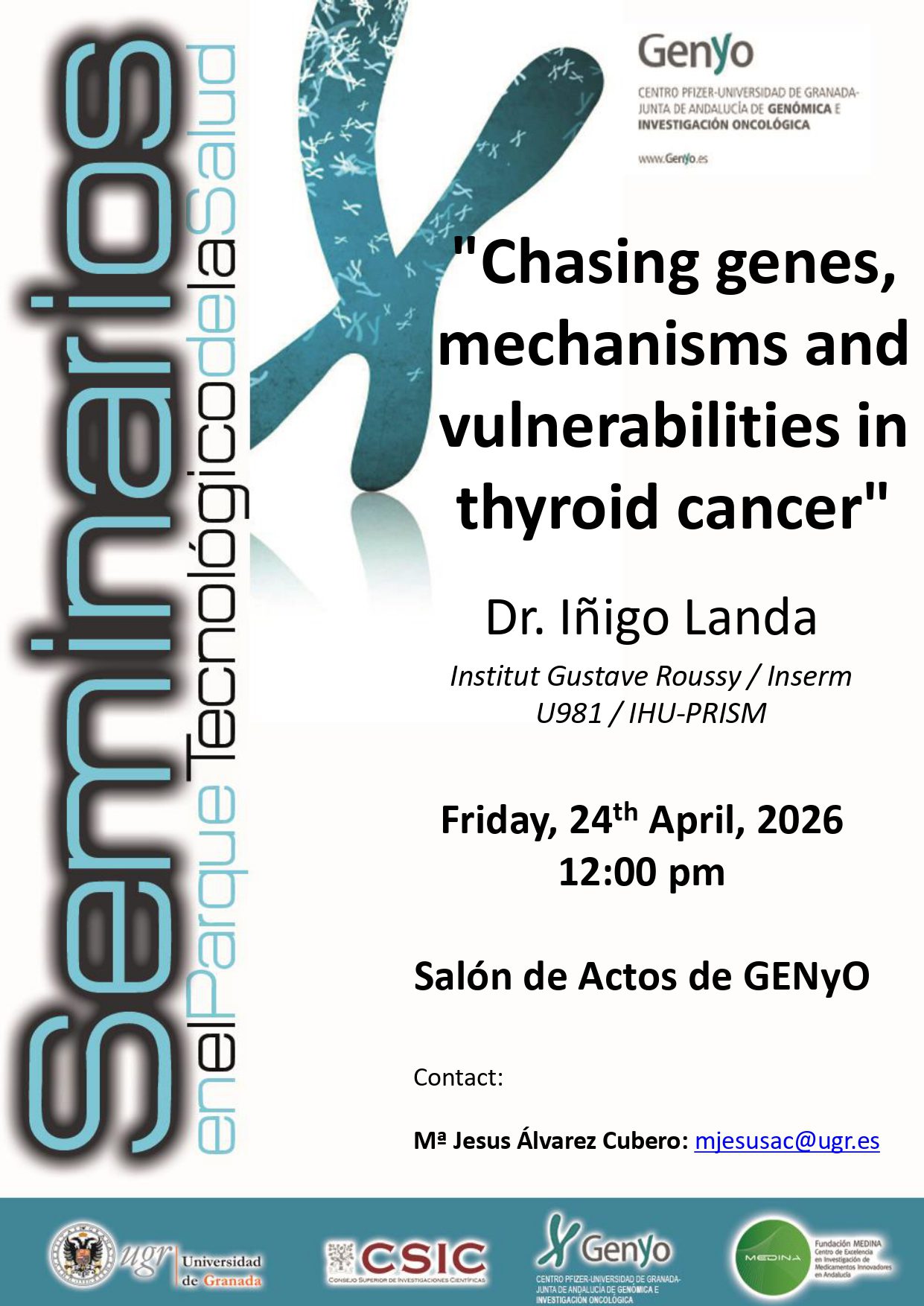
SEMINARIOS EXTERNOS
Fecha y hora: Viernes, 24 de abril a las 12:00h.
Lugar: Salón de actos de GENyO
Ponente/Speaker: Dr. Iñigo Landa (Institut Gustave Roussy / Inserm U981 / IHU-PRISM)
Título/Title: “Chasing genes, mechanisms and vulnerabilities in thyroid cancer”
Contacto/ Contact: Mª Jesus Álvarez
Resume: Although the genomic hallmarks of poorly differentiated (PDTC) and anaplastic thyroid cancer (ATC) are mostly defined, they remain lethal diseases in great need of biomarkers and effective treatments. Compared to the more indolent papillary thyroid cancers (PTC), they are enriched in alterations impacting gene regulation. Among them, mutations in the promoter of TERT (telomerase reverse transcriptase) gene and loss-of-function (LOF) defects targeting epigenetic regulators, such as histone acetyltransferases (HAT; i.e., CREBBP and EP300 genes) are much more frequent in PDTC/ATC vs. PTC. On this seminar, we will first give an overview of the genomic determinants of thyroid cancer pathogenesis. Then, we will show ongoing research in the lab pertaining the mechanistic consequences of TERT promoter mutations and LOF alterations of HAT genes. The overall objectives of these projects are to dissect the downstream effects and therapeutic vulnerabilities of thyroid cancers harboring TERT promoter mutations or HAT LOF alterations. The central hypothesis is that PTC-to-PDTC/ATC evolution often relies on epigenetic reconfiguration. To this end, TERT promoter mutations reactivate TERT expression, which, in turn, changes the transcriptome of thyroid tumors, i.e., contributes to cancer progression via mechanisms other than its canonical role maintaining telomeres. Our data from in vivo models of Tert upregulation points at novel non-telomeric roles for cytokine/chemokine signaling in thyroid cancer progression. We are now employing single-nuclei sequencing and co-culturing assays to understand the cancer-immune crosstalk. We have also performed drug screens to identify compounds that specifically target cells with TERT reactivation. Alternatively, in some ATCs, disrupted HAT function leads to histone acetylation changes at gene enhancers and activate aberrant transcriptional programs fueling cell growth. To address these questions, we will discuss unpublished data on novel thyroid-specific mice of Crebbp/Ep300 loss and CRISPR-edited human cells, which we are leveraging to assess the effects of reduced HAT activity on ATC pathogenesis and epigenetic reconfiguration. We are also employing PROTACs (proteolytic targeting chimeras) to explore synthetic lethal vulnerabilities in HAT-devoid thyroid cancers. The overarching goal of these projects is to provide robust mechanistic underpinnings which can help stratify patients to tailor their therapies, and to inform future studies on other tumor lineages harboring the same mutations.
CV: Iñigo Landa, PhD, is a thyroid cancer scientist. Dr. Landa is currently a Group Leader at the Institut Gustave Roussy in Villejuif, Grand Paris, France. He is also affiliated with Inserm U981 and the IHU-National Precision Medicine Center in Oncology. Before that, he held an Associate Scientist position at the Division of Endocrinology at Brigham and Women’s Hospital, and he was an Assistant Professor of Medicine at Harvard Medical School in Boston, MA, USA. He completed his postdoctoral training in Dr. James Fagin lab at Memorial Sloan Kettering Cancer Center in New York, NY, USA and his PhD studies in Dr. Mercedes Robledo’s group at the Spanish National Cancer Research Centre and the Universidad Autónoma de Madrid, Spain. Prior to this, he got a double BSc in Biology and Biochemistry from the Universidad de Navarra (Pamplona, Spain). The main focus of Dr. Landa’s lab is to identify key genetic events and to understand their underlying mechanisms in thyroid cancer progression. He is particularly interested in genomic alterations affecting gene expression. To this end, his lab employs a variety of techniques in pre-clinical cancer cell systems, genetically engineered mice and patients’ samples.