
No se ha encontrado investigadores para este término.

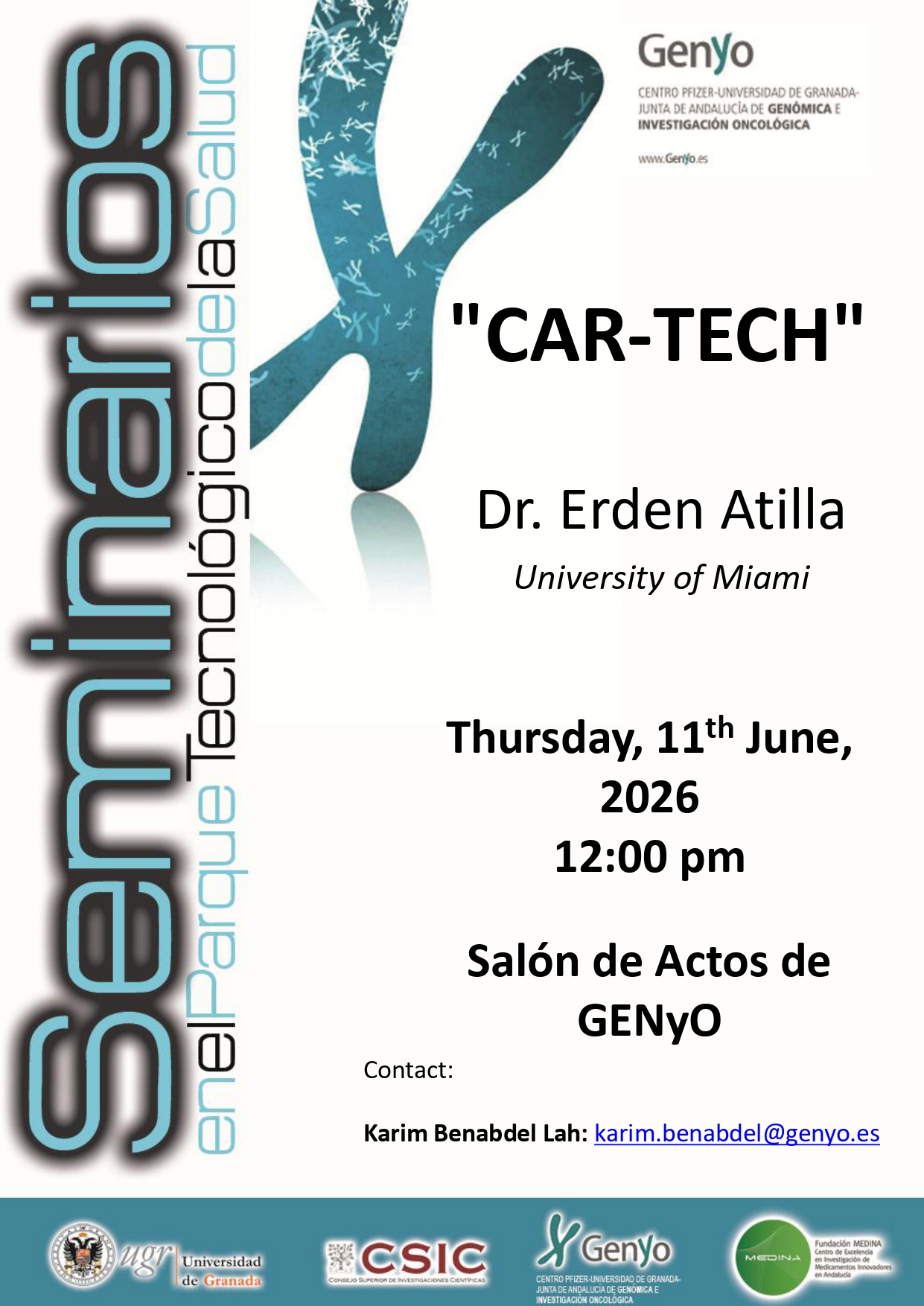
Fecha: Viernes, 12 de Junio
Ponente/Speaker: Dr. Erden Atilla
University of Miami
Título/Title: “CAR-TECH”
Lugar y hora: Salón de Actos de GENyO a las 12:00h.
Contacto: Karim Benabdel Lah: karim.benabdel@genyo.es
Resume: Chimeric Antigen Receptor (CAR) T-cell therapy has emerged as a transformative immunotherapeutic strategy for refractory hematologic malignancies and is now rapidly expanding into solid tumors and autoimmune diseases. In clinical practice, autologous CAR-T manufacturing includes T-cell collection, activation, genetic modification, expansion, and quality control testing. Optimizing each step—from balanced CD4⁺/CD8⁺ T cell selection and cytokine-supported culture to advanced gene-transfer platforms—is critical for achieving potency and persistence. Recent innovations in CAR design, including dual or multi-antigen targeting, cytokine-armored constructs, tunable signaling domains, and inducible safety switches, aim to enhance efficacy while reducing toxicity. Parallel advances in non-viral technologies such as CRISPR editing, transposon systems, and mRNA delivery have improved precision, safety, and scalability. Moreover, in vivo CAR-T manufacturing approaches—where engineered vectors enable T cells to be modified directly within the patient—represent a frontier for simplifying production and broadening accessibility. The development pipeline relies on a continuous bench-to-bedside and bedside-to-bench feedback loop, integrating biological discovery, manufacturing refinement, and clinical translation. Academic centers with Good Manufacturing Practice (GMP) capabilities continue to bridge innovative CAR designs with early-phase clinical testing. Future directions focus on integrating synthetic biology, machine learning, and multi-omics analytics to design adaptive CAR platforms capable of dynamic immune modulation and durable disease control.
CV: Dr. Erden Atilla is a physician‑scientist and Research Assistant Professor in the Division of Transplantation and Cellular Therapy at the University of Miami Miller School of Medicine. He received his medical degree from the University of Ankara School of Medicine in Türkiye, where he also completed residency training in Internal Medicine and fellowship training in Hematology and Bone Marrow Transplantation. He subsequently pursued postdoctoral research at Baylor College of Medicine under Dr. Malcolm Brenner and at the Fred Hutchinson Cancer Center with Dr. Geoffrey Hill, focusing on immunotherapy, stem cell transplantation, and cellular therapy innovation across both clinical and preclinical platforms.
Dr. Atilla’s research program centers on the development of engineered cellular therapies for hematologic malignancies, with a particular emphasis on CAR T‑cell design, optimization, and translational readiness. His work integrates combinatorial antigen targeting, cytokine‑pathway modulation, and safety‑switch engineering to enhance therapeutic potency while mitigating toxicity. He has extensive expertise in developing and applying complex syngeneic and xenograft murine models to evaluate CAR T‑cell efficacy, immune‑mediated toxicities, and mechanisms of resistance—supporting both forward (bench‑to‑bedside) and reverse translational pipelines.
His contributions include advancing off‑the‑shelf and universal allogeneic CAR T‑cell platforms, including donor‑derived T cells engineered to evade host immune rejection and improve persistence. His ongoing efforts focus on modulating the tumor microenvironment in acute myeloid leukemia, optimizing cell‑manufacturing parameters, and designing early‑phase translational studies that bridge mechanistic discovery with clinical implementation. Dr. Atilla collaborates with multidisciplinary teams across national and international partners, contributing to the development of next‑generation immunotherapies and translational hematology initiatives.